In the sample compiled for this report, 24 of 28 older homes in Raleigh's 27609, the North Hills area inside the Beltline, were acquired by builders and redeveloped as new construction, a builder-demand rate of 85.7%, ranking 16th of 189 neighborhoods in this study (Legacy Off-Market, 2026). The older homes that changed hands sold for, on average, 20.3% of what new construction commands on a comparable lot. North Hills is the ZIP in this batch where the zoning envelope does the most work: the sample's minimum lot is 11,498 square feet, more than a quarter acre, and on lots that size inside the Beltline, what the builder is allowed to build determines what the seller's land is worth. The residual formula prices the dirt. The zoning envelope sizes it.
Key Findings
- 85.7% builder-demand rate, ranked #16, 24 of 28 sampled homes built in 1980 or earlier in 27609 were acquired by builders and redeveloped, the 16th-highest composite rank among the 189 neighborhoods studied.
- 20.3% price ratio, older homes sold for barely a fifth of new-build prices on comparable lots, one of the widest old-to-new gaps in the study.
- 11,498 sq ft minimum lot, the largest minimum lot in this batch; inside-the-Beltline parcels run big, and buildable envelope is the binding constraint on value.
- The zoning envelope sizes the residual, Raleigh's residential zoning caps height, setbacks, and lot coverage, which caps what a builder can sell and therefore what the lot is worth.
- One buyer type dominates the record, in more than six of seven sampled transactions, the purchaser bought the lot and removed the ranch.
What does the builder-acquisition record in 27609 actually show?
It shows inside-the-Beltline Raleigh converting its postwar ranch stock into infill sites at a rapid clip. Of 28 homes in the 27609 sample built in 1980 or earlier, 24 were acquired by builders and redeveloped, 85.7%, and the ZIP ranks 16th of 189 neighborhoods on the study's composite ranking. The geography explains the economics: 27609 covers the North Hills area and the established neighborhoods inside Raleigh's I-440 Beltline, where 1950s and 1960s ranch homes sit on large wooded lots minutes from downtown, North Hills' mixed-use core, and the region's job centers. Builders are not buying the ranches. They are buying inside-the-Beltline dirt with sewer, schools, and commute, the three things Raleigh's growth has made scarce.
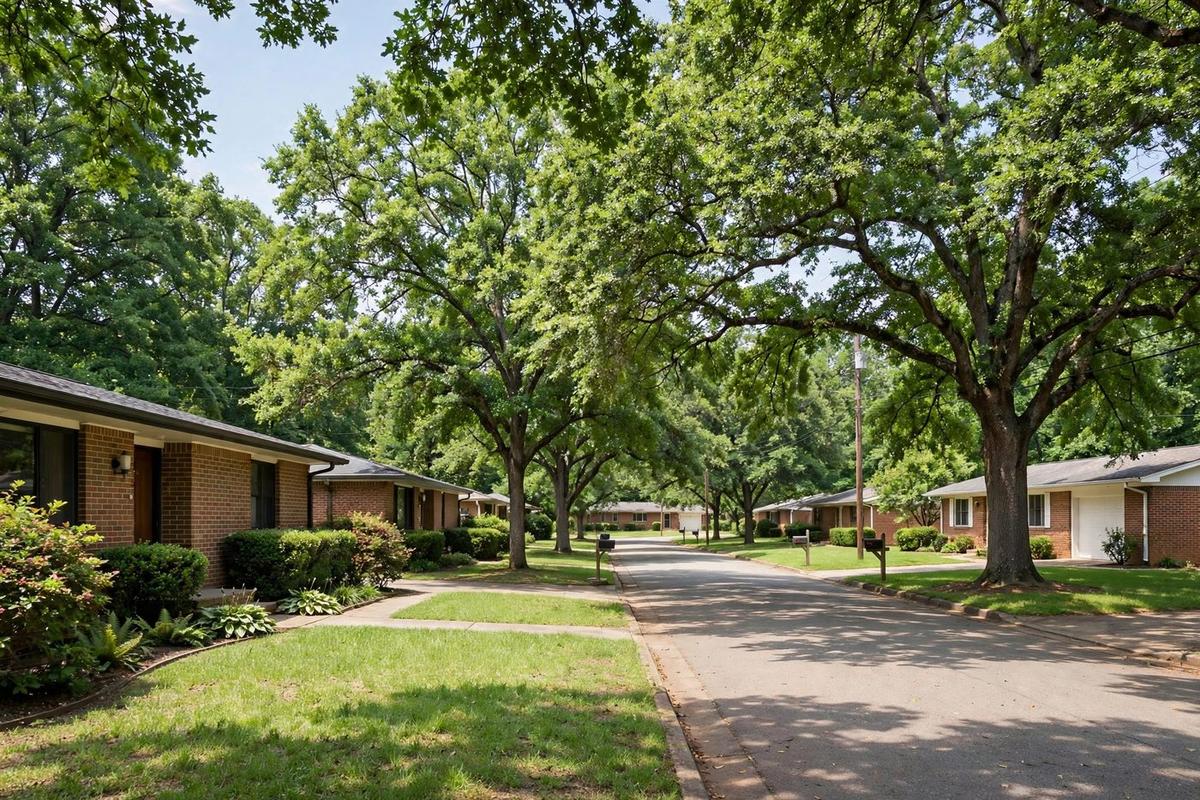
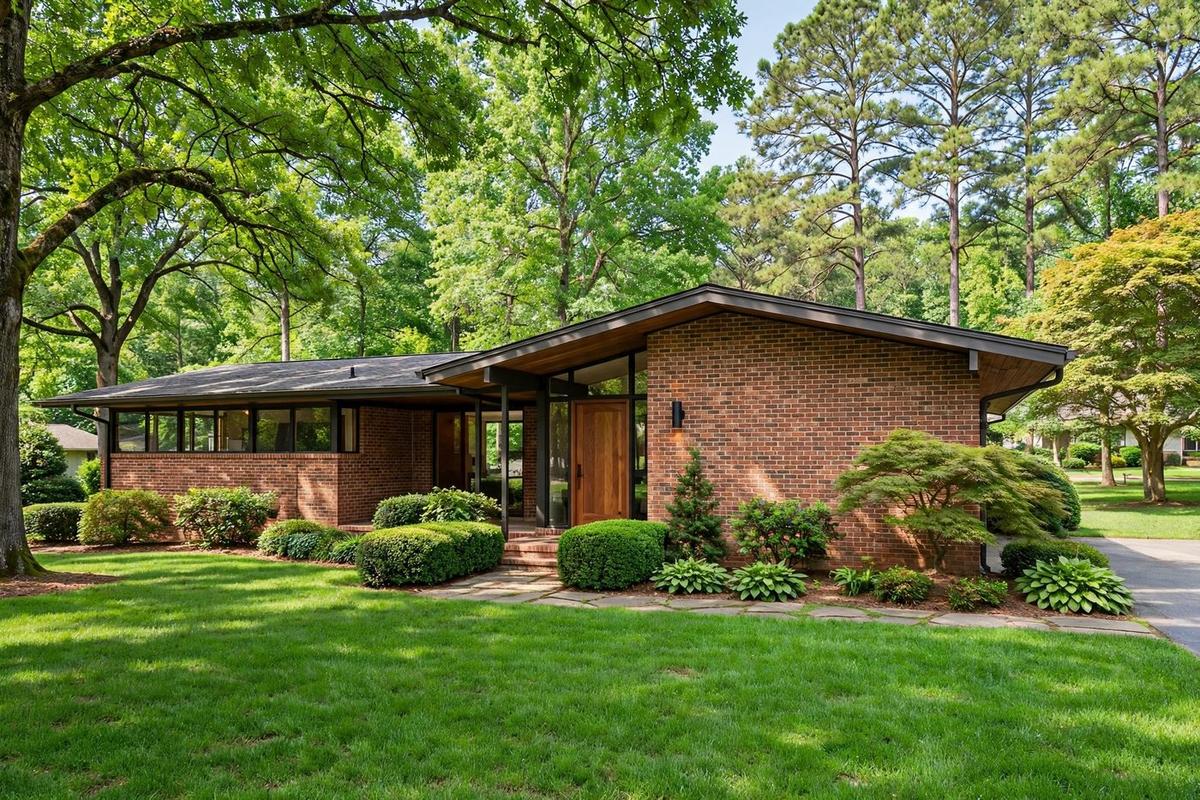
The pattern is visible on the ground. On streets off Lassiter Mill Road, Glenwood Avenue, and the North Hills feeders, original brick ranches sit between new two-story infill homes that fill their envelopes to the setback lines. The North Hills redevelopment, offices, retail, and apartments rising around the old mall site, has pulled the area's land economics upward for two decades. The record shows the residential consequence: the ranch is the interim use, and the interim is ending.
One caution keeps this finding honest: a builder-acquisition rate describes what buyers did with homes they already bought, not what any single seller will receive. That requires the price record, which is the next section.
North Hills is part of a national pattern this series documents. Coconut Grove ranks 15th of 189 neighborhoods with an 83.3% builder-acquisition rate, and Kierland / Scottsdale Airpark / Magic ZIP ranks 17th with an 85.2% rate. Different regions, same buyer logic: the infill lot is the asset, and the ranch on it is the option to build. Westport local submarket ranks 18th of 189 neighborhoods with a 59.5% builder-acquisition rate, a more selective off-market builder market on Connecticut's Gold Coast.
How wide is the gap between an older home and a new build?
Among the widest in the study. In the 27609 sample, older homes sold for an average of 20.3% of the price of new construction on comparable lots. In concrete terms: where a new infill home sells for $1,500,000, the older ranch nearby changed hands for roughly $305,000. Nearly 80% of the new home's value is the inside-the-Beltline lot and the right to build on it, not the ranch.
Averages hide the envelope divide. The 20.3% figure blends lots where zoning allows a 4,000-square-foot new build with lots where setbacks, tree-save rules, or stream buffers shrink the envelope. Two ranches on the same street can carry materially different land values if one's lot yields a bigger buildable footprint than the other's. The structure's condition barely registers in either case; the envelope is the asset.
The honest distinction is between price per square foot of house and price per square foot of lot. Sellers often evaluate offers against what "homes" sell for per square foot in North Hills, a number dominated by new construction. But the older ranch does not compete in that market. It competes in the land market, where the buyer underwrites the envelope: how many finished square feet the zoning allows, at what new-build price per foot, minus costs. The 20.3% ratio is what that underwriting produces when the structure is valued at zero.
What is the lot itself worth?
In 27609, the answer is a function of the zoning envelope, and any seller can learn the inputs. This is the question sellers ask most in every market in this study: how do off-market buyers actually price land? The method is public, and in Raleigh it starts at the zoning map.
Start with the "as-new" value. Recent new infill construction in the North Hills area has sold in the $1.1M to $2M range depending on finished square footage, street, and lot position (Redfin, 2026). Then determine the envelope: Raleigh's residential zoning districts cap building height, front/side/rear setbacks, and lot coverage, the three-dimensional box the builder is allowed to fill. A 12,000-square-foot lot in a district allowing 40% coverage and 35-foot height yields a very different project than the same lot under tighter constraints. Subtract construction cost, permits, financing, and the builder's margin, then subtract site preparation. What remains is the residual land value.
Worked as an illustration, not a promise: a $1,500,000 new-build sale, minus roughly $620,000 in hard and soft construction costs, minus a builder margin near 20%, leaves a residual land value in the neighborhood of $550,000 to $650,000, before site preparation of $20,000 to $35,000 and tree-work costs. That residual is the number a land buyer negotiates against, and it moves directly with the envelope: a bigger allowable footprint means a bigger residual.
Three things move the number in 27609. The zoning envelope is first, setbacks, height, and coverage dictate the sellable square footage. Second is lot size and shape: at an 11,498 sq ft minimum, these are builder-scale parcels, and width determines whether the floor plan works. Third is the street and position relative to North Hills: proximity to the mixed-use core carries new-build premiums that rarely appear in ranch listings. A seller who pulls the zoning for their parcel negotiates from the builder's own math. A seller who does not is negotiating against a feeling, and the feeling is usually the ranch's, not the lot's.
Should you fix it up or sell as-is?
At 85.7%, the record's answer is blunt, but Raleigh sellers should hear the reasoning, not just the number. "Sell as-is or fix it up?" is the most-asked question type in the seller research behind this series, and in 27609 the probability-weighted return on pre-sale renovation is straightforward: with six in seven sampled older homes acquired by builders, a dollar spent on finishes has roughly a six-in-seven chance of returning zero.
Consider the arithmetic. A $100,000 renovation on a 1960 brick ranch, kitchen, baths, systems, might lift the sale price by $70,000 to $90,000 for a live-in buyer, a partial return before months of disruption. If the buyer is a builder, it returns $0, because the builder underwrites the envelope, not the kitchen. Worse, renovation can misprice the seller's expectations: $100,000 of improvements makes the $305,000 land number feel like an insult, when it is in fact the market.
The exception is narrow and specific. A genuinely well-kept ranch on a prime inside-the-Beltline street can sell to the young family priced out of new construction, the "affordable" entry to the school zone, at a real occupant premium. But that buyer is purchasing livability, which means systems, roof, and layout, not cosmetic finishes. And the seller should verify the premise before spending: get a candid read on whether the house is a credible occupant product or a builder acquisition in waiting. Spending on the wrong one converts equity into a builder's site-work line item.
What does listing on the open market really cost?
In North Hills, the listing ledger is dominated by one line: the months it takes the market to teach the seller the land price. The full accounting looks like this.
First, the commission: typically 5% to 6% of the sale price in the Raleigh market. On a $550,000 sale, that is $27,500 to $33,000 off the top (National Association of Realtors, 2025). Second, seller-side closing costs, title, transfer taxes, prorations, commonly another 1% to 2%. Third, concessions: inspections on 1960s ranches routinely surface electrical panels, galvanized plumbing, roof age, and crawl-space issues; credits of $10,000 to $25,000 are normal.
Fourth is carrying cost over market time. Raleigh's market is strong, but older ranches that do not fit either buyer pool cleanly, too worn for families, awkwardly shaped for builders, can take 90 to 150 days and multiple reductions. Every month costs mortgage or equity carry, taxes, insurance, utilities, and maintenance, $3,000 to $5,000 a month on a $550,000 property. Four months burns $12,000 to $20,000 in hold expense. Fifth is the education cost: the price reduction from the ranch-priced list to the land-priced sale, which the carrying costs were spent waiting to accept.
Add the midpoints and a $550,000 list price nets the seller something in the high $400,000s after a normal cycle, before the reduction the record suggests is likely. The net-proceeds figure, not the list price, is what an off-market offer should be measured against.
How do you handle a cash buyer, and how do you tell one from a wholesaler?
Verify funds, verify closings, and get the post-closing story in plain English. "How do I handle cash buyers?" is among the most common real questions sellers ask, and inside-the-Beltline Raleigh draws constant off-market attention, from legitimate infill buyers and from intermediaries alike.
The distinction is structural. A principal buyer like Legacy Off-Market purchases the property itself, with its own capital, and closes in its own name, then places the property with a vetted builder. That is wholesaling done honestly: the company buys, it does not shop your contract around. A contract-flipper signs a purchase contract with no means or intent to close, then shops the contract to a real buyer for a fee, profiting from the spread between the offer and the end buyer's price. The flipper's model requires paying the seller less than a funded buyer would, because the fee comes out of the seller's equity.
Three verifications separate them. First, proof of funds in the buyer's name, dated within the last 30 days, not a pre-approval, not a letter from a "private lender." Second, a record of actually closed purchases: recorded deeds in the buyer's entity name, checkable in county records (Wake County Tax Administration, 2026). Third, the contract itself: a buyer who closes in the name on the contract posts a meaningful earnest-money deposit, typically 1% or more, forfeited if it walks away, and says plainly what happens after closing. A token deposit plus a buyer who will not explain the post-closing plan is the signature of a contract that was never meant to close.
In 27609, the flipper's pitch often leans on the zoning complexity, "I know what can be built here", as a reason the seller should accept a discounted price for the flipper's expertise. The seller can learn the same zoning from the city's public maps in an afternoon. Ask the three questions. Legitimate buyers welcome them.
Is it a bad time to sell an older ranch inside the Beltline?
For a ranch that is a candidate for a builder acquisition, the Beltline land market runs on a longer cycle than the resale headlines. "Is it a bad time to sell?" and "should I wait?" are perennial seller questions, and in Raleigh they usually mean rates and inventory. That frame fits the occupant market. The land market, which set the price on 85.7% of sampled transactions, clears on infill sale prices, construction costs, and the shrinking supply of inside-the-Beltline lots.
Those fundamentals remain constructive. Raleigh's job growth continues to pull demand inside the Beltline, new infill construction sells to equity-rich buyers, and the supply of large builder-eligible lots only shrinks, no new inside-the-Beltline land is being created (U.S. Census Bureau, 2025). The permit record shows builders still replacing the ranch stock (Wake County Tax Administration, 2026). What erodes with delay is the structure: systems age, and the occupant buyer pool narrows, while the envelope, the actual asset, holds its value.
That yields the two-part answer. It can be a bad time to list an aging ranch on the MLS, where it will absorb months of market time while the seller learns the land price one reduction at a time. It is a structurally ordinary time to sell the same property off-market to a land buyer, whose bid is anchored to infill comps and the zoning envelope rather than resale sentiment.
Is skipping the MLS worth it for a North Hills seller?
Inside the Beltline, where the zoning envelope sizes the project and the ranch is incidental, the listing process sells the wrong asset to the wrong audience. The off-market alternative offers five concrete advantages. First, privacy: zero showings, zero open houses, no public marketing period, on streets where a for-sale sign becomes neighborhood news. Second, a closing you schedule: 7 to 21 days versus 60 to 120-plus days for a listed older ranch, with a leaseback if the move needs a bridge. Third, no commissions: none of the typical 5% to 6% (National Association of Realtors, 2025), roughly $17,000 on a $315,000 older-home sale. Fourth, no seller-side closing costs: none of the usual 1% to 2%, so the 6% to 8% that commissions plus closing costs normally consume, over $21,000 on that $315,000 transaction, is kept off-market. Fifth, no inspections or repairs: no $10,000 to $30,000 in repair credits or price reductions, a true as-is sale, the honest format when the buyer's underwriting starts with the dirt.
Methodology and limitations
This report draws on three source types. First, Legacy Off-Market's builder-acquisition sample for the 189-neighborhood study: 28 homes in 27609 built in 1980 or earlier, 24 acquired by builders and redeveloped, with an average older-home sale price of 20.3% of new-build prices on comparable lots (Legacy Off-Market, 2026). Second, county records: the Wake County Tax Administration's parcel and permit data, used to confirm builder-acquisition and new-construction activity directionally (Wake County Tax Administration, 2026). Third, market data: dated sold listings from Redfin and Zillow for 27609, the basis for the new-build price ranges cited (Redfin, 2026; Zillow, 2026). The 348 seller questions in the research behind this series selected the questions answered here; they are not evidence.
What was not done: no title search on any property, no inspection of any home, and no verification of any new-build sale beyond its listing record. The price ranges illustrate from dated listings rather than appraising, and the residual-land arithmetic is a simplified model.
The central limitation is the sample. Twenty-eight homes selected for older-home characteristics cannot describe every parcel inside the Beltline. The 85.7% figure describes the sample, which was built to find builder acquisitions, so treat it as evidence of rapid ranch-to-infill conversion, which the permit record supports, not as a census of the ZIP code.
Conclusion
So how do Raleigh builders price a North Hills builder-acquisition lot? On the record assembled here, they price the envelope: the new-build sale price the zoning allows, minus construction cost, margin, and site preparation, which is why 85.7% of sampled older homes were acquired by builders and older homes changed hands at 20.3% of new-build prices. The ranch is the interim use on inside-the-Beltline dirt. The interim is ending lot by lot, and the seller's proceeds depend on whether they price the ranch or the envelope.
The throughline is consistent. The zoning envelope, not the kitchen, determines the land residual. The listing's full cost, commission, concessions, carrying time, and the education of reductions, is the number every off-market offer should be measured against. And the flipper's spread is the tax on sellers who do not verify.
Legacy Off-Market buys directly inside the Beltline and in the other 188 neighborhoods in this study, as a principal with its own capital, then places each property with a vetted local builder, with proof of funds and recorded closings behind every offer. North Hills sellers can reach the acquisitions team at 401-219-4207 or aidansowa@outlook.com.
When six out of seven ranches were bought for the envelope beneath them, is your listing selling the house, or the months it takes to learn the zoning already priced it?
Frequently Asked Questions
How do I know if Legacy Off-Market buys in my ZIP code?
The company buys in the 189 neighborhoods ranked in this builder-acquisition study, with 27609 (North Hills, Raleigh, North Carolina) ranked 16th. Enter your ZIP in the coverage checker to confirm, or call 401-219-4207.
Will I get less selling off-market than listing with an agent?
Net proceeds are the comparison. A listed ranch loses commission, closing costs, inspection concessions, and carrying costs over market time. The off-market offer has none of those deductions.
Do I need to make repairs before selling off-market?
No. Off-market means as-is. When the buyer's underwriting starts with the dirt, every dollar of renovation is a dollar the bulldozer will not credit.
How fast can an off-market sale close?
Seven to 21 days is the usual off-market timeline, versus 60 to 120-plus days for a listed older ranch. The seller sets the date, with a leaseback option if the next home needs more time.
How is an off-market buyer different from a wholesaler?
A principal buyer purchases in its own name with its own capital, forfeits a real deposit if it walks away, and discloses what happens after closing. Legacy Off-Market buys with its own capital and then places the property with a vetted builder, disclosed up front. A contract-flipper never intends to close and shops your contract for a fee. Verify funds, recorded closings, and a plain-English post-closing explanation.
What does Legacy Off-Market need from me to make an offer?
The address, your timeline, and permission to pull public records. No showings, no staging, no open houses. Call 401-219-4207 or email aidansowa@outlook.com.
Sources
- Legacy Off-Market, 2026. Builder-acquisition sample, 189-neighborhood study: 28 homes sampled in 27609, 24 acquired by builders and redeveloped, avg. older-home price 20.3% of new build. Market data.
- Legacy Off-Market, 2026. Coverage checker and company site. Industry report.
- National Association of Realtors, 2025. Typical seller commission structures, Raleigh market. Industry report.
- Redfin, 2026. Recently sold homes and new construction, ZIP code 27609, Raleigh NC. Market data.
- U.S. Census Bureau, 2025. QuickFacts: Raleigh city, North Carolina. Government data.
- Wake County Tax Administration, 2026. Parcel and permit records, Raleigh NC. Official record.
- Zillow, 2026. Home values and recently sold, 27609. Market data.